

Hospice: CHoiCe Trust
Written by: CHoiCe Trust
Message: Supporting families in need is connected to a career built around helping others.
Thabang’s Story: A Journey Through Palliative Care
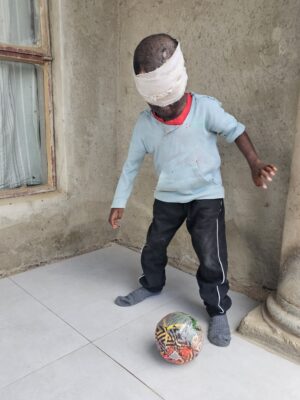
Thabang*, a five-year-old boy living with his family in a community outside of Tzaneen in Limpopo Province, was referred to CHoiCe Trust by another organisation operating in the area after concerns were raised about his wellbeing. His poor physical condition at the time, which included what appeared to be untreated sores and bandages, raised questions about whether he was being neglected or abused. CHoiCe’s social worker intervened and discovered that Thabang was not being abused but was instead dealing with a serious condition that needed urgent medical attention. She immediately referred the matter to the CHoiCe palliative care team, and Jamela, one of the nurses, visited Thabang for the first time in May 2026.
Not only did the boy have a serious skin condition (xeroderma pigmentosa**), but his eye also had a protruding cancerous mass that was causing significant impairment to his vision. He was the youngest in a family of eight and was the only child from his mother; limited resources made it difficult for his mother to access the healthcare he desperately needed.
Jamela, as a palliative care nurse, connected the boy and his mother with healthcare professionals and a broader palliative care network and helped the family obtain referrals to an ophthalmologist and dermatologist. The challenges, however, did not end there. The family faced multiple delayed hospital visits and even postponements of a scheduled operation to relieve the growing pressure caused by the protrusion in his eye. After helping to navigate through the process, CHoiCe advocated amongst health professionals in the sector and arranged sponsorships to support his care, including necessary scans, blood tests and, in June 2026, an operation was performed by a specialist eye-health organisation to remove his eye.
Thabang continued to experience challenges throughout his recovery, including infection and pain, and Jamela supported him through this. He was referred to a dietitian for nutritional support and has been provided with food supplements that he will continue to receive each month. The CHoiCe social worker, who had been engaged early on to support Thabang and his mother, also secured a disability grant for the household, which provided some additional financial support.
There is still more to do: while Thabang’s eye has now healed, CHoiCe continues to support the households, including subsequent visits to a dermatologist to remove skin lesions with a follow-up appointment scheduled for October to remove more.
CHoiCe is also currently engaging with the ClemenGold Foundation, an ECD organisation based in the area, to test some early childhood development activities which can be done in the home. This will ensure that, despite his ongoing recovery, Thabang is able to grow and develop and enjoy the interaction with the learning process.
For Jamela, like many of her colleagues at CHoiCe, supporting families in need is connected to a career built around helping others. After joining CHoiCe 27 years ago to support people and families affected by HIV and AIDS, her passion for helping people, along with the support of her colleagues and supervisor, continues to motivate her to continue this work.
The CHoiCe intervention has had a profound impact on this family. In a letter written to the organisation by the family in August 2026, they shared:
“Because of your support, our child was able to get the help they needed. We went to many hospital[s] looking for assistance, but we were turned away and could not find help for our child’s pain… We [are] deeply grateful for everything you have done, your compassion has made a real difference in our lives and we will never forget your generosity.”
*Name changed for purposes of confidentiality.
**A rare genetic disorder causing extreme sensitivity to ultra-violet radiation from the sunlight as a result of the body’s DNA-repair mechanism being unable to fix damage done by sunlight. People with this condition have a risk of non-melanoma skin cancer roughly 10,000 times that of the general population, and a melanoma risk about 2,000 times greater. Without effective protection, patients can develop dozens of skin cancers each year. Eye complications are also common and 20-30% of patients also experience neurological involvement (such as hearing loss and developmental delay). Without appropriate management, people with the condition experience a significantly lower life expectancy.


