

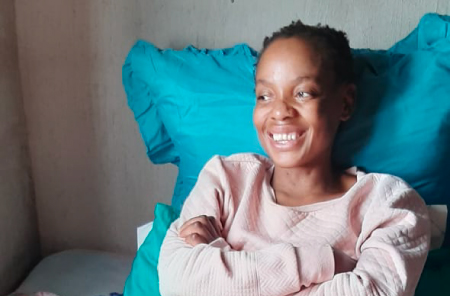
Hospice: Estcourt Hospice
Name of patient: Unknown
Written by: Unknown
Diagnosis: HIV positive (on ART), recto vaginal fistula, paraplegic with limited upper body movement, on Warfarin for blood clots
A 35-year-old lady with two children, the youngest of whom was 18 months, was referred to Estcourt Hospice by the local primary health care clinic for palliative care.
Upon admission, her brief history indicated that she was HIV positive (on ART) and was suffering from recto vaginal fistula and paraplegia. At the first encounter, the patient was bedridden and could not move either her upper or lower limbs. She was also experiencing severe pain. The recto vaginal fistula had left her incontinent and catheterised, with continuous diarrhoea, and this added to her sense of hopelessness. Unable to care for herself or her children, she was being cared for by her aunt.
Palliative Care Services Offered
The following interventions have assisted her progress:
- A proper assessment of her pain was conducted.
- Counselling was provided so that she can understand her condition.
- A reassessment of her palliative care needs.
- Encouragement to help her live more positively, despite her condition.
- A co-operative action, together with her aunt, to receive family.
- Weekly visits were administered for palliative care. She was also connected with an internal social worker.
There was also a proper assessment and identification of physical problems. This saw the patient referred to a hospital doctor and physiotherapist.
Current Progress
The patient’s upper limbs can now move, and she is making progress with more movement in her lower limbs as well. Exercises by the palliative care team and physiotherapist are still ongoing. With pain control, the patient is now experiencing less pain and is able to sit on her own, with no pressure sores.
As her mobility improved, she was slowly weaned off the uterine catheter, and her diarrhoea was brought under control. With ongoing emotional support, her attitude changed and she was eventually able to move back into her own home, regaining her independence. The patient is receiving her grant, which assists her financially. She is bright, happy, and has a far more positive mindset. The patient adheres to her treatment and her palliative care is going consistently well. She is appreciative of what the hospice has done to help and support her, including transporting her for treatment, physiotherapy sessions and blood checks.
UPDATE August 2026
The patient developed severe dropped foot from months of immobility, and had surgery a month ago to correct it. With continuous support from the rehab team, she is now able to stand with a walker. Her mobility continues to improve, and she is able to sit up and manage some tasks on her own, such as cooking and caring for herself, with the help of her children and partner. She describes a renewed strength: regaining her independence, having a positive outlook, and knowing that Hospice is there to support her as she continues her rehabilitation.


