

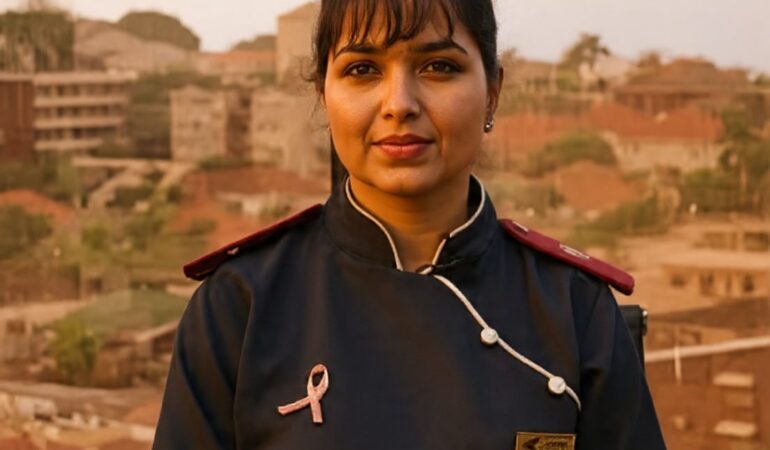
Introduction:
What is your name?
Kashmiri Raghubar
Which hospice do you work for?
Highway Hospice
What do you do there?
I was a Home Care Sister for 7 years and 3months and am the H.O.D. of Home Care for the last 3 years and 5 months.
How long have you been there?
10 years and 8 months
In-depth:
1. Why did you decide to focus on palliative care?
My stepdad was diagnosed and died from cancer in 2008, and that’s when it dawned on me, that when a person has a terminal diagnosis, there are no follow up appointments at active treating facilities and the patient and family are told, ‘’there is nothing more we can do for you’’. Highway Hospice and Palliative Care helped us through one of our darkest periods. That lesson stayed with me and I wanted to make sure other families had support.
2. What gives you the greatest fulfilment?
Knowing that I serve a positive purpose.
3. What do you find the most challenging?
Knowing that the consequences of a family or patient in denial, is greater suffering, because it guides treatment, medication and counselling choices. The longer one is in denial, the later pain and symptoms can be managed appropriately.
4. What do you think that you personally bring to your job that reflects who you are as a person?
Empathy, and humour, sometimes light, sometimes dark, sometimes dry. It breaks the ice, offers reprieve for a moment, to a patient or family usually engulfed by grief, opens the door to topics of acceptance and allows me to cope.
5. How do you take care of your own health and balance?
I talk a lot and am very open about how I am feeling, as a form of informal debriefing, thereafter I enjoy solitude, a walk in the sunshine preferably through a park, so I can be reminded of the beauty of life by the sounds of a chirping bird, or children’s laughter in the distance. My greatest comfort however is found and spent with my family.
6. What is your advice to anyone else wishing to join your profession?
You have to be comfortable with the idea of death being a natural part of life and almost every patient you meet will die. It is very humbling to know that this is a process that you can help manage but cannot control. This profession is one where, money won’t buy you time and the problem cannot be fixed, rehabilitated or cured. Your role is to let the journey unfold but with as little pain or suffering as possible. The reward is a renewed appreciation for even the little things in your own life.
7. What is your advice to anyone given a life-threatening diagnosis?
Don’t let fear and denial rob you of a peaceful journey. At the very least live like you were, the day before you heard your diagnosis and at the most, live it like you have placed your notice at your job, and the world is yours for the taking. Do the things that need to be done and say the things that need to be said.
8. What is your advice to the loved ones of anyone who is given a life-threatening diagnosis?
You are a human being, made up of flesh, blood and bone. You too have a breaking point. Carer fatigue is real. You are not cold or cruel for venting. Don’t feel guilty, you are normal.
9. How do your loved ones feel about the work that you do?
Proud and very supportive.
10. What do you like the most about the hospice that you work with?
The principals upon which our founder Greta Schoeman opened the Highway Hospice 44 years ago and the fact that we are still an organisation that supports patients and families, when they are told, ‘’there is nothing more we can do for you’’, and there aren’t any follow up appointments, when diagnosed with a terminal illness.
11. Do you have a “motto” that you tend to live by that you would like to share?
If you have given it your best shot and things still don’t go according to your plan then you have to accept, ‘’it is what it is’’ and work with that.


